Sunday, 27 February 2011

I am back

When I started this blog, my only aim was to keep friends and family updated on my field work in Bolivia. I have now decided to open it up a bit. I hope we can use this space to discuss news and new publications on the geo-archaeology and paleo-ecology of the Bolivian lowlands and the Amazon region. I have also added a link (on the right) to my new twitter account. Well, as I am this blog’s owner, I suggest we start with my latest paper :-) which will be published in the next number of the Journal of Archaeological Science. You can access it clicking here.

This is the abstract:

The Llanos de Moxos (LM), Beni, Bolivia, with its impressive number of pre-Columbian earthworks, is an ideal region for studying past human–environment interactions in the Amazonia. Agricultural raised fields are among the most striking of those earthworks. They can offer us valuable information about the region’s agricultural carrying capacity and the nature and extent of human occupation in pre-Columbian times and, therefore, help adopt better informed conservation and development strategies for Amazonia in the future. However, before tackling these issues we need to further our understanding of why pre-Columbian raised fields were built and how they were managed in the past. Published data on raised fields in the LM is contrasted with new data gathered from field and remote sensing images. Raised fields have been analysed in relation to the hydrology, soil, topography and paleoclimate of the areas where they are found. In light of this new data we believe that there are grounds to question the current model that suggests raised field agriculture provided high yields without the need of fallow periods, representing a kind of pre-Columbian green revolution. Our alternative proposal suggests that raised field agriculture allowed pre-Columbian peoples to mitigate the risk of more intense and frequent flooding than is experienced today in the LM. We show that raised fields were built only in those areas where there were no alternatives, which do not coincide with those areas where pre-Columbian societies seem to have flourished and reached high levels of social complexity.

Monday, 20 September 2010

Paper Accepted

My last paper about Pre-Columbian agriculture has been accepted for publication on the Journal of Archaeological Science!!!
In the next days I will give you more details, it should go on-line on Sciencedirect quite soon.
Tomorrow I hope I will be able to leave the Beni for Santa Cruz. They have been burning the pampa for weeks and the air is so smoky that there is not enough visibility for the plains to land on Trinidad airport...
they are so crazy...and stupid!!! Because of the fire hundreds of hectares cultivated with cacao have been lost!!!
Anyway...life goes on...and I will probably take the bus :-(

Friday, 10 September 2010

Confluence point - 14ºS 65ºW

http://www.confluence.org/confluence.php?visitid=17219

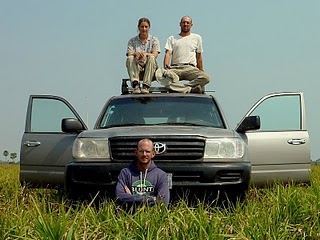
On our way back from San Ramón to Trinidad we – a international and multidisciplinary team of young researchers from the University of Bern (Switzerland) – had the chance to reach one of the many unexplored confluence points within Bolivia.

With this we marked the first confluence point in the Llanos de Moxos, which contains the department of Beni. This is the region where we work reconstructing the landscape evolution. The Llanos de Moxos constitute the southwestern part of the Amazon Basin. The climate is characterized by two marked seasons: the rainy season from October to April, when precipitations can reach 500 mm per month, and the dry season with monthly precipitation of <50

From the main road we entered the Estancia “Curisal”. After getting the permission from the farm manager (“encargado”) we drove a few kilometers throughout the green ocean of “pampa”, only interrupted by some “Totaí” palms. Eventually, we reached the confluence point with our Tractor-like Land Cruiser (Model 2000; 4500cc). This confluence is maybe one of the easiest to reach – at least during the dry season.

Tuesday, 7 September 2010

La "gallina" dalle uova extra-large


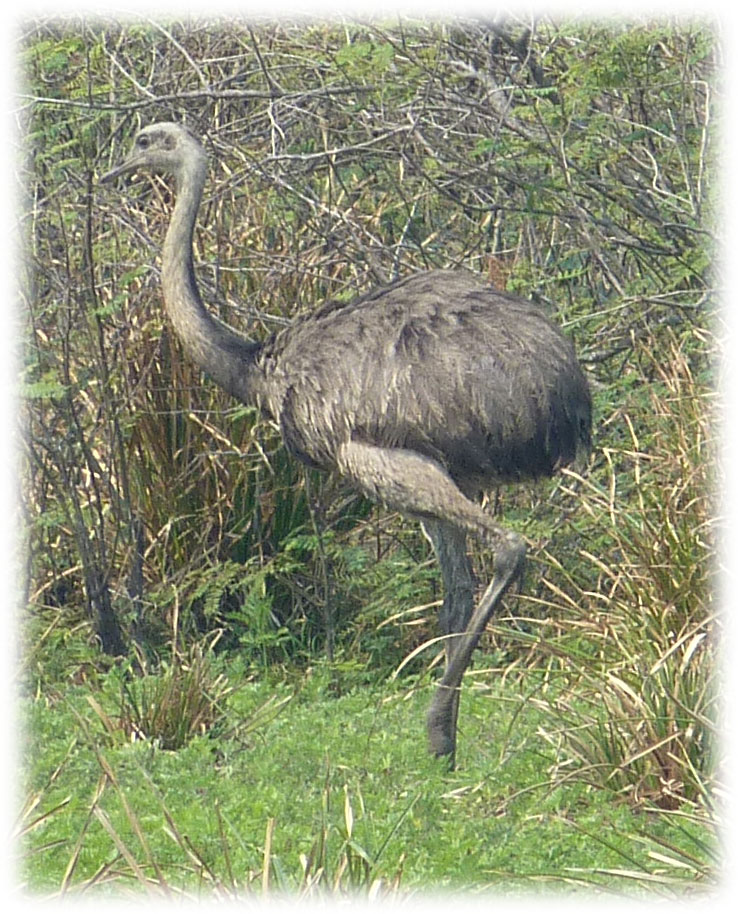
Uno dei precedenti post, quello che descrive come preparare una frittata Mojeña, ha suscitato una certa curiosità. Che "gallina" fa uova così grandi?
Eccovela: si chiama Rhea americana, nome locale piyù (si pronuncia pigliu) ed è il parente americano dello struzzo.

Monday, 23 August 2010

In the field

In these days I am going on secondary roads which are far from any main road or village. So, it is full of anilmals: the swamp deer is quite difficult to see, the alligator and the bird are everywhere. Anna and Bernhard are on a trip to Santa Ana, they will be back next week. I will keep working alone with the help of Don Jorge, the official chofer I had when I did the survey of Lomas in 2006-07. We spend all the time chatting about "ganaderos" gossip :-)


Thursday, 19 August 2010

Lake San Josè


We spent the last 3 days doing the complete profile of Lake San Josè. A huge lake of 6 by 3 km.
Our friend Chiqui, on the right, helped us a lot. He guided us and he got the boat and the motor.


As you see, we improved our coring table. Now it is a two pieces device: a larger base and a little box on the top. In the picture you see it up side down while we transport it to the very centre of the lake. The water level in the centre was about 1.2 meters.


Here me and Bernhard during the opeation of taking out the cores. It was quite an hard work, we got 3 profile inside the lake and 2 outside with really interesting results... but, unfortunately, I need to wait for 14C before I can say anything for sure. Just as first guess...I would not say this lake has a tectonic origin...

Thursday, 12 August 2010

How to prepare an egg in Moxos

Get one egg from locals.


If you want to save the shell, make 2 little holes as shown in the picture.


Take an human pump like Bernhard to make the egg come out from the shell.


Fry some onions and add the egg.


Enjoy your animal house serving of scrambled egg :-)