Tuesday, 22 March 2011

Terra preta

Terra preta, also known as Amazonian Dark Earth (ADE), is a really interesting phenomenon. ADE is an anthropogenic soil, mostly found in Brazilian Amazonia, characterized by its dark colour. The ADE’s colour derives from the high amount of charcoal and organic matter contained. It is actually the high quantity of charcoal and organic matter that “defines” terra preta. The incomplete combustion of wood produces charcoal with highly aromatic humic substances, which, once oxidized, a process that takes centuries, increase the soil’s ability to hold nutrients and hence its fertility. Terra preta is a very good soil for agriculture because it is rich in nitrogen, phosphorus, potassium and calcium. The major source of the incomplete combusted charcoal is cooking fire (Glaser et al. 2001)
From an archaeological point of view, should be quite clear what terra preta is: the result of a prolonged human occupation of a site where people have cooked and dumped wastes for hundreds of years. But, many archaeologists do not agree with this interpretation, for them terra preta was “created specifically for permanent farming” (Erickson 2008). It is the evidence of intensive pre-Columbian agriculture! I have read several papers on this topic: while many of them give for granted the “intensive agriculture” interpretation none of them provide archaeological evidence to support it. Because of all the speculations that have been done on the terra preta phenomenon, everybody now is looking for terra preta in its study site!! We have reached the extreme of scholars who said “With the exception of low levels of organic matter and charcoal, Johannes Lehmann (personal communication, 2004) favorably compares the Mound Inventory sample [in the Llanos de Moxos – Bolivian Amazon] to those of anthropogenic ADE found in Brazil” (Erickson & Balee 2006:200-201). How is that possible that you can call something “terra preta” if there is no charcoal and no organic matter??
The reason for this attachment to the productive aspect of terra preta is simply because it is sexy. We can learn from the past; we can establish development projects with indigenous communities and they can re-discover their own ancient agriculture; thanks to terra preta, intensive agriculture in the Amazon can be sustainable etc.
Yes, we have to admit that the terra preta rhetoric is cool. But, should science be driven by the coolness of its conclusions?
Ref.
Erickson, C.L. (2008): Amazonia: the historical ecology of a domesticated landscape. - In: Silverman, H. & W. Isbell (eds.): Handbook of South American Archaeology. - New York: Springer: 157-183.
Erickson, C.L. & W. Balée (2006): The historical ecology of a complex landscape in Bolivia. - In: Balee, W. & C.L. Erickson (eds.): Time and complexity in historical ecology. New York: Columbia University press: 188-233.
Glaser, B., Haumaier, L., Guggenberger, G. & W. Zech (2001): The “Terra Preta” phenomenon: a model for sustainable agriculture in the humid tropics. - In: Naturwissenschaften 88(1): 37-41.

Thursday, 17 March 2011

10 days to my first step on USA and, guess what? I’m scared!

I am going to California for the 76th congress of the SAA. Being my first time in the USA, my girlfriend warned me: “…me dijo la ali que para entrar en los EEUU tienes que llenar un formulario online 48 horas antes de viajar, sino no te dejarán entrar […] también me recordó la Karen que las ciudades americanas no son como las europeas, que uno no puede andar por donde le da la gana a las tantas de la noche, que hay que ir con un poco de cuidado, si puedes dejar el pasaporte en el hotel y salir con el carnet de identidad mejor, por si te roban. También me recordó que San Francisco es la ciudad de EEUU con más homeless, porque el clima es bueno y la seguridad social es mejor que en otras ciudades - por lo tanto muchos homeless migran ahí. Bueno, que lo tengas en mente, que San Francsico no es Barcelona o Pisa o Berna vale???”. Ok, that is just because she loves me and she is a bit overprotective…but then I got a nice present: The Rough Guide to California. Well, I started reading it and…. see what is written in the “basics” chapter: “Hitchhiking: In Southern California, standing anywhere near a highway is an invitation for a quick death”! And, on page 36: “If the police do flag you down, don’t get out of the car, make any sudden moves, or reach into the glove compartment, as the cops may think you have a gun. Simply sit still with your hands on the wheel; when questioned, be polite and don’t attempt to make jokes.”

I stopped reading the guide. Come on!!! I grew up in Sicily, I have lived in Bolivia, Ireland the UK, USA can't be that bad right?

Now, I have just watched this video on youtube and I can’t believe it. Is it really like that? Should I fear the police more than San Francisco’s homeless?

Thursday, 10 March 2011

The importance of maize

Maria Bruno has recently published a very interesting paper where she presents the results of the analysis of carbonized plant remains from the site of Loma Salvatierra, in the Llanos de Moxos region of Bolivia (Department of Beni). The most common crop encountered was maize, but she also tentatively identified chili pepper, sweet potato, jack bean, peanuts, squash, and cotton.
Maria's work suggests that in the mounds region of the eastern Llanos de Moxos maize was the most important crop (together with yucca) in sustaining the large population that seems to have inhabited this area. What is striking is that there are no raised fields here! Have those who provided the scientific background for this anything to say?

Ref:

Bruno, M. C. (2010). Carbonized Plant Remains from Loma Salvatierra , Department of Beni , Bolivia. Zeitschrift für Archäologie Außereuropäischer Kulturen, 3, 151-206.

Lombardo, U., & Prümers, H. (2010). Pre-Columbian human occupation patterns in the eastern plains of the Llanos de Moxos, Bolivian Amazonia. Journal of Archaeological Science, 37, 1875-1885. Here

Sunday, 27 February 2011

I am back

When I started this blog, my only aim was to keep friends and family updated on my field work in Bolivia. I have now decided to open it up a bit. I hope we can use this space to discuss news and new publications on the geo-archaeology and paleo-ecology of the Bolivian lowlands and the Amazon region. I have also added a link (on the right) to my new twitter account. Well, as I am this blog’s owner, I suggest we start with my latest paper :-) which will be published in the next number of the Journal of Archaeological Science. You can access it clicking here.

This is the abstract:

The Llanos de Moxos (LM), Beni, Bolivia, with its impressive number of pre-Columbian earthworks, is an ideal region for studying past human–environment interactions in the Amazonia. Agricultural raised fields are among the most striking of those earthworks. They can offer us valuable information about the region’s agricultural carrying capacity and the nature and extent of human occupation in pre-Columbian times and, therefore, help adopt better informed conservation and development strategies for Amazonia in the future. However, before tackling these issues we need to further our understanding of why pre-Columbian raised fields were built and how they were managed in the past. Published data on raised fields in the LM is contrasted with new data gathered from field and remote sensing images. Raised fields have been analysed in relation to the hydrology, soil, topography and paleoclimate of the areas where they are found. In light of this new data we believe that there are grounds to question the current model that suggests raised field agriculture provided high yields without the need of fallow periods, representing a kind of pre-Columbian green revolution. Our alternative proposal suggests that raised field agriculture allowed pre-Columbian peoples to mitigate the risk of more intense and frequent flooding than is experienced today in the LM. We show that raised fields were built only in those areas where there were no alternatives, which do not coincide with those areas where pre-Columbian societies seem to have flourished and reached high levels of social complexity.

Monday, 20 September 2010

Paper Accepted

My last paper about Pre-Columbian agriculture has been accepted for publication on the Journal of Archaeological Science!!!
In the next days I will give you more details, it should go on-line on Sciencedirect quite soon.
Tomorrow I hope I will be able to leave the Beni for Santa Cruz. They have been burning the pampa for weeks and the air is so smoky that there is not enough visibility for the plains to land on Trinidad airport...
they are so crazy...and stupid!!! Because of the fire hundreds of hectares cultivated with cacao have been lost!!!
Anyway...life goes on...and I will probably take the bus :-(

Friday, 10 September 2010

Confluence point - 14ºS 65ºW

http://www.confluence.org/confluence.php?visitid=17219

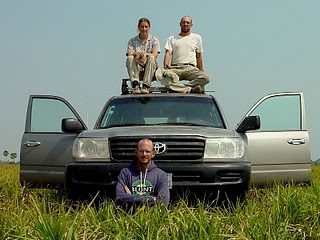
On our way back from San Ramón to Trinidad we – a international and multidisciplinary team of young researchers from the University of Bern (Switzerland) – had the chance to reach one of the many unexplored confluence points within Bolivia.

With this we marked the first confluence point in the Llanos de Moxos, which contains the department of Beni. This is the region where we work reconstructing the landscape evolution. The Llanos de Moxos constitute the southwestern part of the Amazon Basin. The climate is characterized by two marked seasons: the rainy season from October to April, when precipitations can reach 500 mm per month, and the dry season with monthly precipitation of <50

From the main road we entered the Estancia “Curisal”. After getting the permission from the farm manager (“encargado”) we drove a few kilometers throughout the green ocean of “pampa”, only interrupted by some “Totaí” palms. Eventually, we reached the confluence point with our Tractor-like Land Cruiser (Model 2000; 4500cc). This confluence is maybe one of the easiest to reach – at least during the dry season.

Tuesday, 7 September 2010

La "gallina" dalle uova extra-large


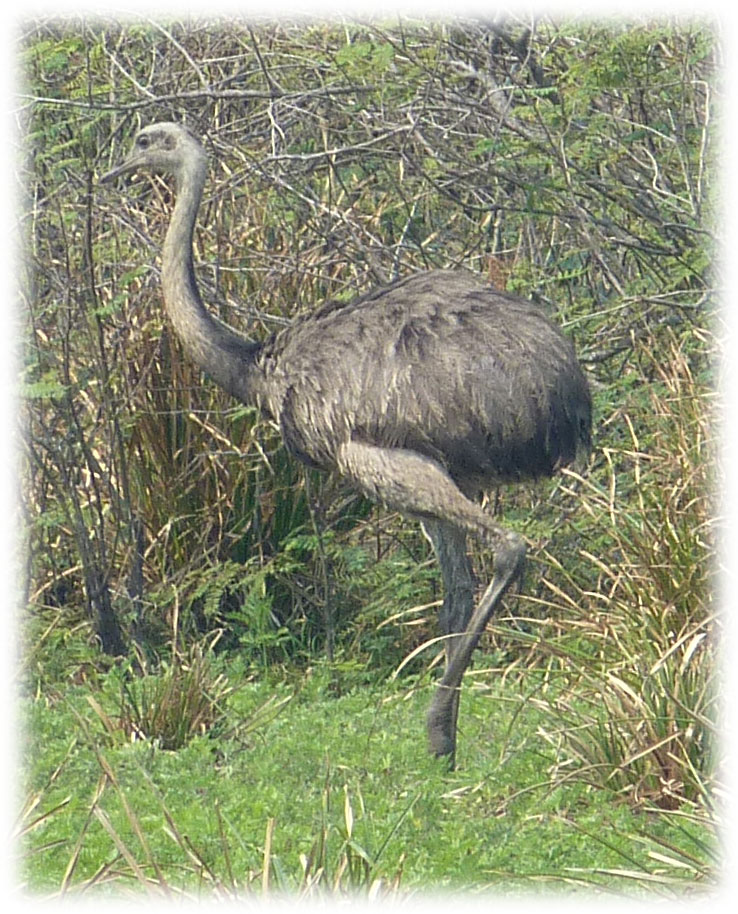
Uno dei precedenti post, quello che descrive come preparare una frittata Mojeña, ha suscitato una certa curiosità. Che "gallina" fa uova così grandi?
Eccovela: si chiama Rhea americana, nome locale piyù (si pronuncia pigliu) ed è il parente americano dello struzzo.